


Best Whitening Cream in Pakistan Without Side Effects: Labels, Risks and Warning Signs
If you are searching for the best whitening cream in Pakistan without side effects, start with a realistic limit: no cream can guarantee zero reactions for every person. This guide explains label checks, warning signs that need medical assessment, and the limits of what packaging can tell you.
A complete-looking label does not rule out undeclared ingredients. Appropriate laboratory testing can detect specific undeclared substances in the tested sample; a test does not establish every ingredient or guarantee overall safety.
This guide is published by GlutaPro, a skincare retailer and authorized seller of Gluta White products in Pakistan.
Quick answer: The safest approach is not a specific product name. It is a method: read the full ingredient list, reject creams with no label or hidden prescription ingredients, and keep expectations gradual.
See a dermatologist promptly if your skin changes in the ways described below. Labels and symptoms are screening tools, not proof.
Why Fast Results Are Not Proof of Safety
Some whitening creams appear to work within days. That speed deserves scrutiny, not celebration. Topical corticosteroids (steroids) constrict blood vessels and suppress inflammation, which can make skin look brighter and calmer almost immediately.
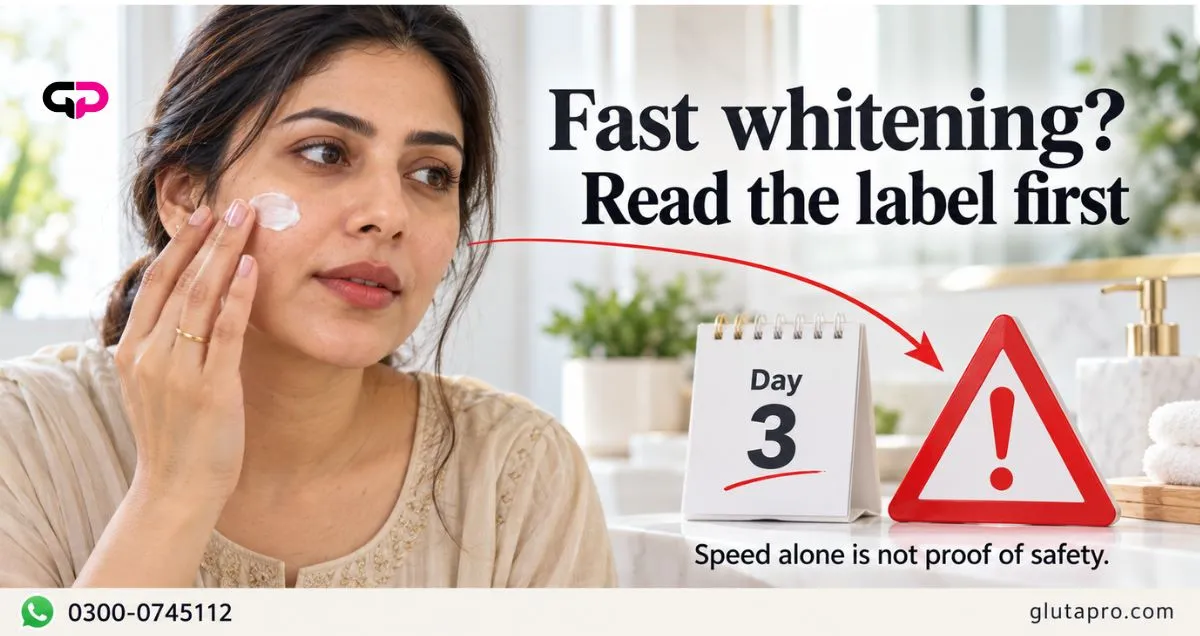
Mercury compounds block melanin formation aggressively. Both effects look like fast whitening, and both carry documented risks.
Speed alone never proves a cream contains a hidden drug. Some legitimate brightening ingredients also show early surface improvement. The point is narrower: dramatic whitening within days is a reason to read the label carefully and stay alert.
It is not a diagnosis of what is inside the jar. There is also an important distinction to keep. Dermatologists do prescribe steroids and hydroquinone for specific diagnosed conditions, under supervision, for limited periods.
That supervised medical use is different from a cosmetic cream bought over the counter that may contain the same substances without declaring them. One is a monitored treatment. The other is an unknown exposure.
Skin Changes That Need Medical Assessment
The changes below have been reported in connection with prolonged unsupervised use of steroid-containing fairness creams. Each one can also have other causes, from rosacea and sun damage to hormonal conditions.
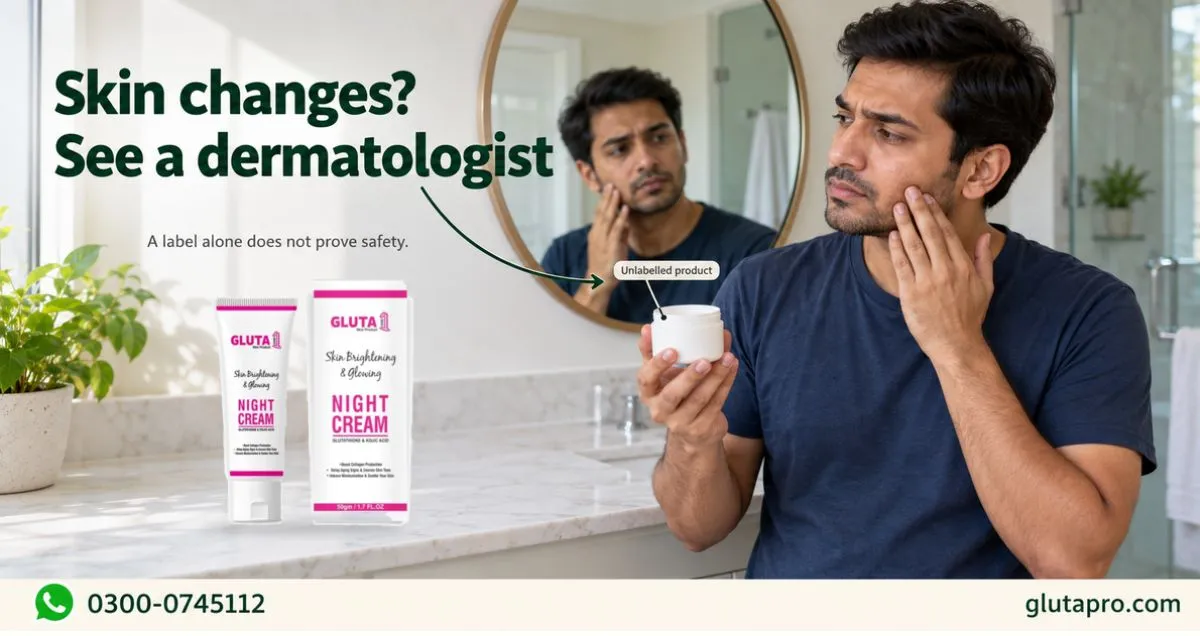
Only a clinician examining your skin can assess what is happening. Treat this section as a prompt to seek care, not as a home-diagnosis checklist.
Skin that looks thinner or bruises easily. Thinning of the skin (atrophy) is among the most commonly documented local effects of potent topical steroids. Skin may look translucent, feel fragile, or tear and bruise with minor bumps.
Sun damage and natural aging can also thin skin, which is why a clinician’s assessment matters.
Fine visible veins on the cheeks. Small dilated blood vessels (telangiectasia) can appear when the skin’s support structure weakens. Dermatology sources note these may persist even after the cream is stopped.
Similar veins also occur with rosacea and long-term sun exposure.
Persistent redness, burning or stinging. Ongoing redness that spreads, sometimes with a burning sensation, has been reported both during misuse and after stopping. The UK medicines regulator MHRA describes withdrawal reactions that can include intense redness spreading beyond the treated area, burning, peeling and oozing within days to weeks of stopping.
Other forms of dermatitis can look similar, so this sign also needs clinical interpretation.
Acne-like bumps that behave unusually. Steroid-related breakouts tend to appear as uniform red bumps, sometimes with whiteheads, and may not respond the way ordinary acne does. A hospital-based study in Nawabshah, Pakistan, listed acne among the common findings in patients who had misused whitening creams.
Ordinary acne, of course, has many other causes.
Unusual facial hair growth. Increased fine or coarse facial hair (hypertrichosis) has been reported in studies of facial steroid misuse. Hormonal conditions can also cause this, so it is an assessment prompt, not a conclusion.
Darkening after stopping. Rebound pigmentation is a recognized pattern: the skin darkens again, sometimes beyond its original tone, after a fast-acting cream is stopped. Melasma and unprotected sun exposure can also cause darkening.
Mercury Concerns and Household Exposure
Mercury is banned in skin-lightening cosmetics under the Minamata Convention. The US Food and Drug Administration warns consumers against skin products that contain it.
On a label it may appear as mercury, mercurous chloride, calomel, mercuric, mercurio, Hg, or ammoniated mercury. The FDA advises extra suspicion for products with handmade labels or no ingredient list. Avoid products with missing or unreadable ingredient information, and ask for a complete ingredient list you can understand.
Short-term effects reported by the FDA include rashes, skin discoloration and scarring. With longer exposure, mercury can damage the kidneys, nervous system, digestive and immune systems.
It can also interfere with brain development in unborn and very young children. Exposure is not limited to the user: household members, especially children, can be exposed through mercury vapors or by touching treated skin.
If you suspect a product contains mercury, the FDA’s general advice on skin product safety is to stop using it, wash exposed skin, seek medical advice, and keep the product contained while you ask local authorities about disposal.
Do not try to test or treat suspected mercury exposure at home.
How to Read a Whitening Cream Label
You do not need a chemistry background to screen a label. You need to know which names matter and which packaging patterns signal trouble.
Steroid names to scan for. Clobetasol propionate, betamethasone valerate, betamethasone dipropionate, mometasone, fluocinolone, triamcinolone, beclomethasone, dexamethasone and hydrocortisone are medicines, not fairness ingredients.
A cosmetic cream declaring any of them is a product that requires medical supervision. Vague phrases like “anti-inflammatory complex” prove nothing either way. Suspected undeclared ingredients cannot be confirmed without laboratory testing.
Mercury names to scan for. Mercury, mercurous chloride, calomel, mercuric, mercurio, Hg and ammoniated mercury all indicate mercury content. Any one of them is a reason to reject the product.
Hydroquinone needs context. Hydroquinone is a prescription-only ingredient in several jurisdictions, including under US FDA rules, and it is used by dermatologists for specific conditions.
Prolonged unsupervised use carries documented risks, including exogenous ochronosis (a blue-black darkening of the skin). A supervised prescription treatment and an undeclared additive in a cosmetic cream are not the same situation, so do not equate them.
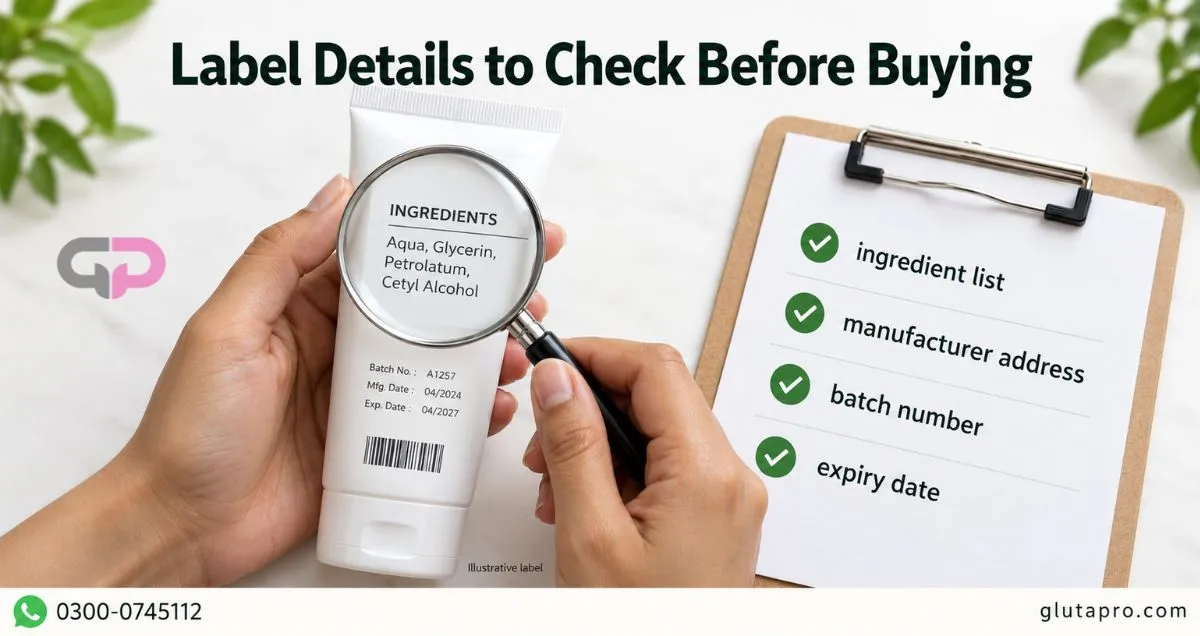
Label details to check before buying. A full ingredient list, the manufacturer’s name and address, a batch number, and manufacturing and expiry dates.
According to Business Recorder, PSQCA adopted Standard PS 3228-2017 fixing the legal mercury limit for skin creams at 1 ppm (1 mg/kg). Missing manufacturer details or missing dates are patterns seen in enforcement actions, not just minor oversights.
Red-flag claims. Treat these as warnings, not selling points: “7-day fairness”, “permanent whitening”, “no side effects guaranteed” or “100% safe”.
A “without side effects” claim does not replace a complete ingredient list or reliable safety information. Safe brightening from legitimate actives is gradual and depends on consistent sun protection.
What Labels, Codes and Patch Tests Cannot Prove
A complete and professional-looking label is reassuring, but it is not proof of what is inside. Undeclared ingredients are, by definition, absent from the label.
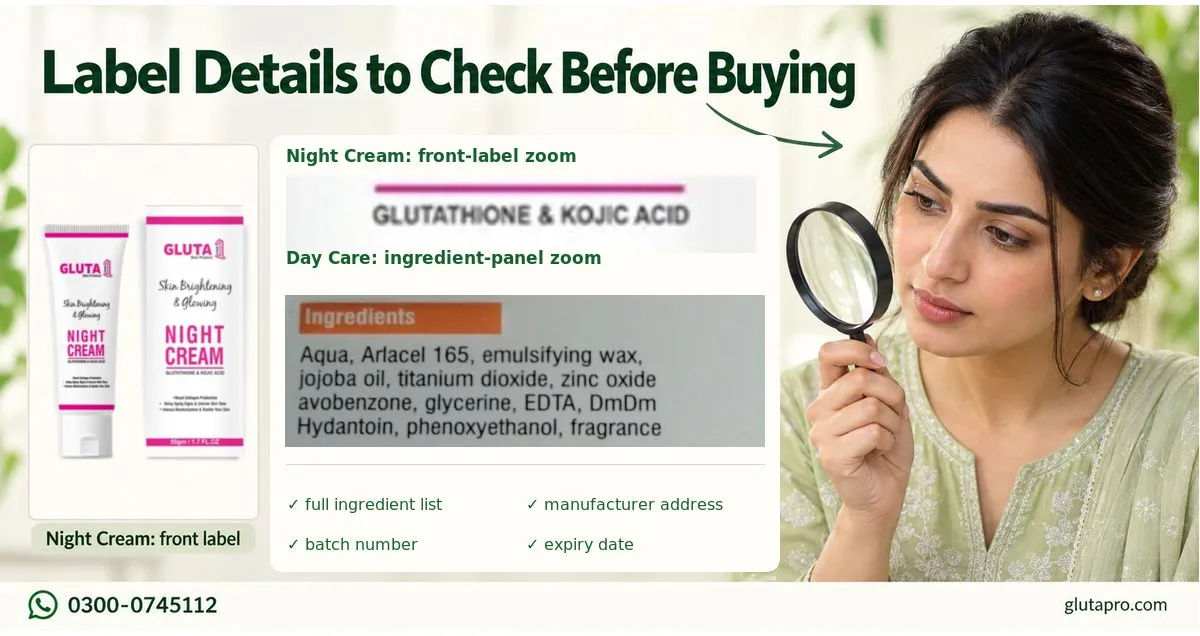
Appropriate laboratory testing can detect specific undeclared substances in the tested sample; a test does not establish every ingredient or guarantee overall safety. Keep that limit in mind before trusting any jar on packaging alone.
Authenticity codes have a similar limit. Gluta White’s one-time verification code confirms that a code is valid when checked at the official portal, which helps against counterfeits. It does not certify ingredient safety.
Our original vs fake guide explains what the code check does and does not establish.
Home patch tests are worth doing and have real limits. The American Academy of Dermatology describes at-home testing over about seven to ten days: apply the product to a small area such as the underside of the forearm, twice daily in the normal amount.
Watch for redness, itching, burning or bumps. This may reveal a skin reaction before wider use; it does not diagnose an allergy or guarantee future tolerance. It cannot detect hidden mercury, and a reaction-free home test does not guarantee long-term safety.
Pakistan-Related Regulatory Actions and Testing Reports
Pakistan’s regulators have acted on this problem, and the actions are worth knowing because they show the risk is documented, not theoretical.
In January 2026, the Drug Regulatory Authority of Pakistan (DRAP) issued a rapid alert after laboratory analysis confirmed an undeclared prescription-only corticosteroid in a cream marketed for skin fairness. DRAP declared the product unregistered and falsified under the Drugs Act, 1976.
That is an official enforcement case from Pakistan’s own drug regulator.
Separately, the Competition Commission of Pakistan acted against deceptive marketing of mercury-containing whitening creams. It served notices to 12 cosmetic companies in May 2024 and opened a nationwide investigation in October 2025, as documented in the Zero Mercury Working Group’s letter to the Commission and reported by Dawn.
In April 2026, the Pakistan Standards and Quality Control Authority (PSQCA) suspended the licenses of six beauty cream brands after laboratory testing by the Pakistan Council of Scientific and Industrial Research found mercury, arsenic and microbiological contamination in violation of Pakistan Standard 3228:2025.
Manufacturing and sale were prohibited until the products comply, as reported by ProPakistani.
Independent testing adds another layer. Non-governmental testing initiatives have reported mercury far above the 1 ppm limit under Pakistan Standard 3228 in samples of Pakistan-made whitening creams. These were sample-based screenings, not surveys of the whole market, and screening methods carry their own qualifications.
They do not establish that every Pakistani cream is contaminated. They do establish that contamination has been found repeatedly enough for regulators to act.
What to Do After Using a Suspect Cream
If mercury is suspected: stop using the product, wash skin that contacted it, and seek medical advice promptly. Keep the product sealed and away from children while you ask local health authorities about disposal.
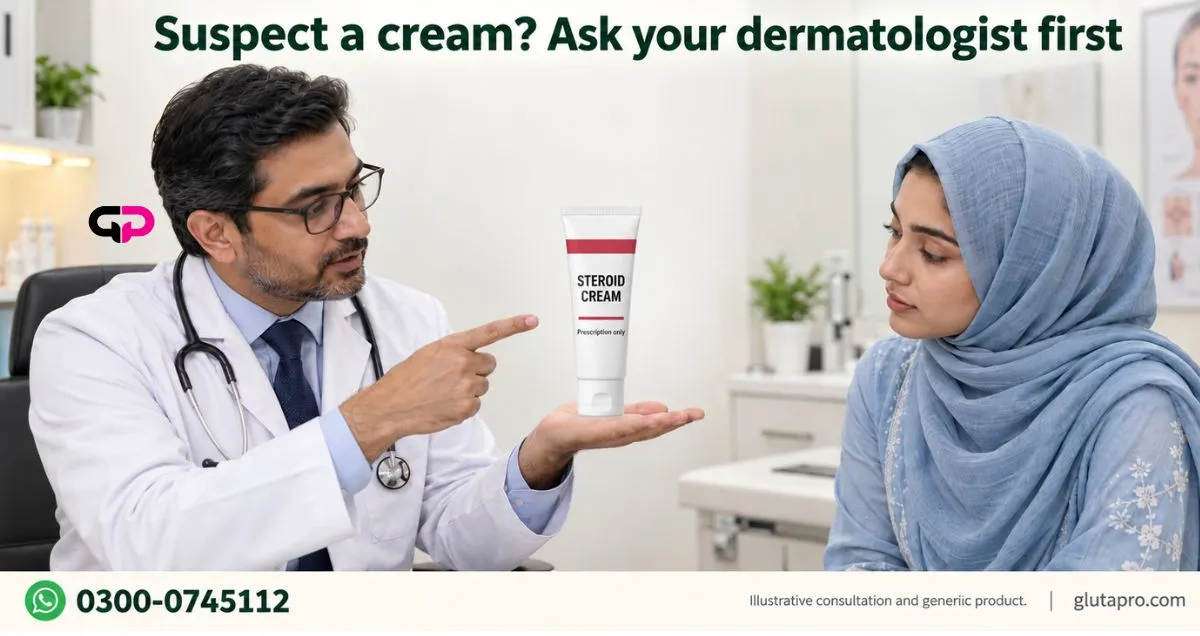
Do not attempt home testing or home treatment for suspected mercury exposure.
If undeclared steroids are suspected: particularly after prolonged use, seek prompt medical advice about how to discontinue the product. Do not create your own taper or restart it without advice.
The clinician decides whether stopping, supervised tapering, or another approach fits your situation. This applies to unlabelled cosmetics. If a doctor prescribed the steroid for a diagnosed condition, follow that doctor’s instructions instead of this general guidance.
If an official recall identifies your product or batch, follow the regulator’s instructions and seek medical advice about your exposure.
While waiting for your appointment: keep the routine minimal. A gentle cleanser, a fragrance-free moisturizer and daily sunscreen cover the basics. Avoid new actives, scrubs and harsh exfoliants until the skin stabilizes.
Sun protection can help limit further sun-related pigmentation, but it does not replace assessment of a suspected adverse reaction.
Report what happened. Tell your healthcare provider about the product and consider reporting the adverse reaction to the national regulator. Reports are one reason enforcement actions like the ones above exist.
Realistic Expectations and Product-Specific Information
Legitimate brightening works gradually over weeks of consistent use, and sunscreen is non-negotiable throughout. An overnight-transformation claim is not reliable evidence of safety or effectiveness and does not establish what the product contains.
Judge progress in evenness and clarity of tone, not in shades on a chart. If your search for the best whitening cream in Pakistan without side effects brought you here, keep this frame: the method matters more than the product name.
Product-specific information sits separately from the warnings above. For side-effect information about a specific Gluta White cream, see our Gluta White cream side effects guide.
For a comparison of whitening cream options with disclosed ingredients and checked prices, see our best whitening cream in Pakistan guide. For context on products marketed with medicated claims, see our medicated whitening cream guide. Naming a product here implies nothing about the warnings discussed earlier.
Where to Start: Creams with Published Ingredient Lists
No cream is free of reactions for everyone. If you want a starting point with a disclosed formula, these night creams list their ingredients and come with clear directions. Patch test first and use sunblock during the day.
| Cream | Key ingredients (as listed) | Price |
|---|---|---|
| Gluta White Night Cream (Jar) | Glutathione 0.5%, Alpha Arbutin 1%, Glycolic Acid 5%, Kojic Acid 2% | Rs 2,250 |
| Gluta White 3-in-1 Night Cream | Glutathione, Alpha Arbutin, Niacinamide | Rs 1,799 |
| GlutaOne Night Cream | Glutathione, Kojic Acid, Vitamin C | Rs 2,299 |
Some users notice a visible difference within 1 week, while others need 2 weeks or longer.
Frequently Asked Questions
These are the questions readers ask most when looking for the best whitening cream in Pakistan without side effects.
How can I tell if my whitening cream contains steroids?
Read the ingredient list for the steroid names listed above, and treat missing labels as a red flag on their own. Warning signs like unusually fast whitening, thinning skin or rebound darkening raise suspicion but prove nothing by themselves.
If you suspect undeclared steroids, particularly after prolonged use, seek prompt medical advice about how to discontinue the product. Do not create your own taper or restart it without advice.
What happens if I stop a steroid cream suddenly?
After prolonged use of a potent steroid, stopping abruptly can trigger withdrawal reactions: intense redness that may spread beyond the treated area, burning, stinging, peeling or oozing within days to weeks.
The MHRA advises not restarting the cream without medical advice if symptoms return. A dermatologist should manage the transition, which is why prompt assessment matters more than any home schedule.
Is hydroquinone safe in whitening creams?
Hydroquinone sits in two different worlds. Under dermatologist supervision for a diagnosed condition, it is a legitimate prescription treatment in several jurisdictions.
In an over-the-counter cosmetic cream, especially undeclared or at high percentages without supervision, it carries documented risks including irritation and, with prolonged unsupervised use, exogenous ochronosis. The setting and the supervision change the safety picture completely.
Why did my skin get darker after I stopped a whitening cream?
Rebound pigmentation is a recognized pattern after stopping fast-acting creams, particularly those that may have contained undeclared steroids. Sun exposure during and after use makes it worse, and underlying melasma can also resurface.
A dermatologist can distinguish rebound from other causes and plan next steps, which usually start with strict sun protection rather than another strong cream.
General-information note: this guide is educational and does not replace professional medical advice. Skin changes described here need individual assessment by a qualified clinician.


