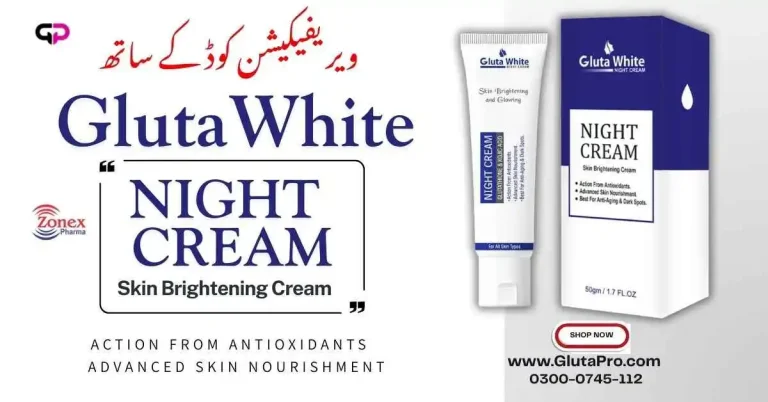


Best Medicated Whitening Cream in Pakistan (2026 Guide)
Looking for the best medicated whitening cream in Pakistan? GlutaPro sells the products compared in this guide and is not the manufacturer. Prices are our listed selling prices, checked 13 October 2026; product-label claims are identified separately from demonstrated results.
Quick answer: The word “medicated” in a seller’s description alone does not establish a product’s regulatory classification, approval or prescription status. Pakistan’s drug regulator, DRAP, does include medicated cosmetics among regulated therapeutic goods, which is exactly why the word deserves scrutiny rather than blind trust. This guide explains how to read the claim, compares three GlutaPro products on disclosed ingredients and listed prices, and covers label reading, home testing and precautions. GlutaOne Night Cream (Rs 2,299) is our featured option at GlutaPro, sold as a medicated night cream with named actives. The Gluta White Cream Jar (Rs 2,250) publishes selected ingredient percentages, and the Gluta White 3-in-1 (Rs 1,799) is the budget pick. One warning matters more than any ranking: steroid-containing creams require medical supervision, and any whitening cream that hides its ingredient list is a red flag.
What “Medicated” Whitening Cream Actually Means
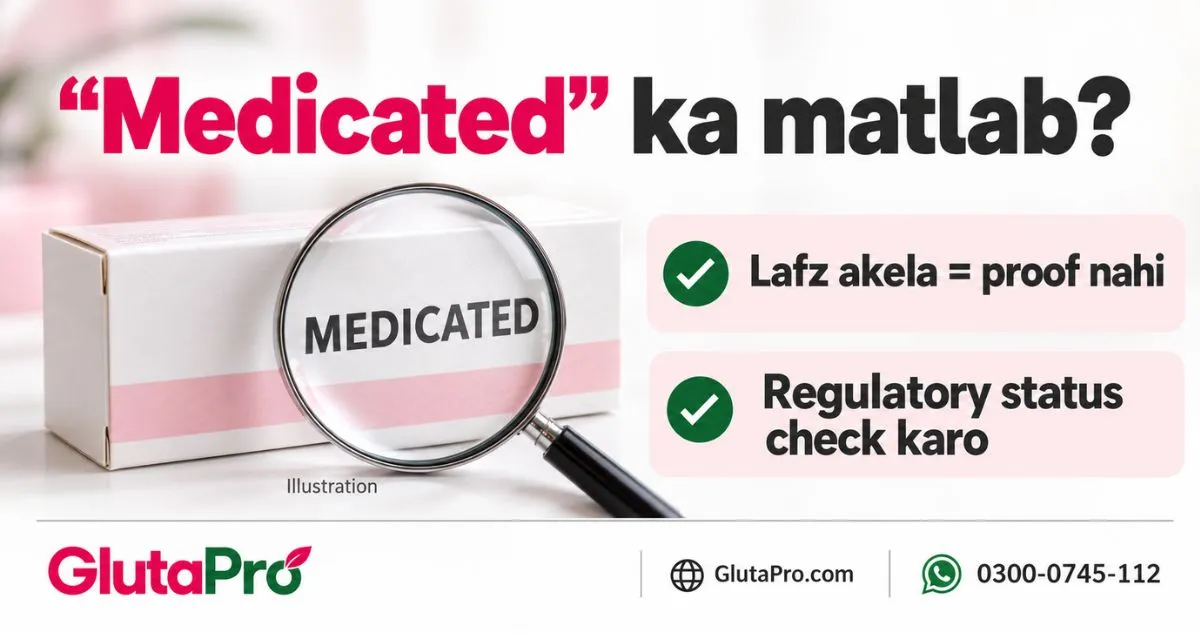
The word “medicated” in a seller’s description alone does not establish a product’s regulatory classification, approval or prescription status. That sentence is the foundation of this entire guide, because Pakistan’s drug regulator, DRAP, explicitly includes medicated cosmetics among regulated therapeutic goods. In other words, “medicated” is a meaningful regulatory concept, but a seller printing it on a box does not prove the product holds any particular classification. The word is a claim that invites verification, not a conclusion you can draw from the label alone.
In the Pakistani market, sellers typically use “medicated” to signal a formula built around active ingredients such as glutathione, kojic acid, vitamin C derivatives, alpha arbutin or niacinamide. That usage may be accurate or it may not. The only way to judge is the disclosed ingredient list, so treat the word as the start of your questions rather than the answer: which actives are named, and is the full list disclosed?
Why the word alone proves nothing
Three points keep shoppers from being misled by this word. First, cosmetic products can also contain named actives; the presence of functional ingredients does not by itself sort a product into a “medicated” category. Second, percentage disclosure does not establish classification either. A brand that prints percentages is being more transparent, which is valuable, but transparency and regulatory classification are different things. Third, whether a prescription is needed depends on the product’s actual ingredients and regulatory status, not on the marketing word on the front. A cream labelled “medicated” might need no prescription at all, while a plain-looking cream with hidden prescription-only ingredients would require medical supervision regardless of what its label claims.
The practical takeaway: when you see “medicated,” ask what regulatory standing the product actually holds and read the ingredient list. If the seller can answer both, the word has weight. If not, it is decoration.
The steroid warning: what DRAP found
The most serious misuse of trust in this market involves creams that contain corticosteroids without declaring them. In January 2026, DRAP issued a rapid alert after laboratory analysis confirmed that a cream marketed as a cosmetic fairness product contained undeclared prescription-only corticosteroids; DRAP declared the product unregistered and falsified under the Drugs Act, 1976. This is not a theoretical risk. It is a documented enforcement case from Pakistan’s own regulator.
Topical steroids are medicines that require medical supervision. They are not fairness ingredients, and prolonged unsupervised use is associated with documented harms including skin thinning, steroid acne and pigmentation changes. Practical red flags that suggest a cream may contain undisclosed steroids: dramatic whitening within a few days, no ingredient list on the pack, or a “mix cream” prepared at a shop counter with no brand accountability. If you are currently using a cream you suspect contains steroids, see a dermatologist before stopping or continuing on your own, since changes after long-term use can trigger rebound flares that need medical management. Nothing in this guide replaces that advice.
Three creams compared: published ingredients and prices
Shoppers comparing medicated whitening cream options in Pakistan usually want the same thing: the most verifiable information for the price. The table below compares three products sold by GlutaPro on disclosed actives and listed prices, checked 12 October 2026. Only GlutaOne is explicitly sold as a medicated night cream; the other two are included for their disclosed ingredients and verifiable packaging, not because this guide assigns them a classification.
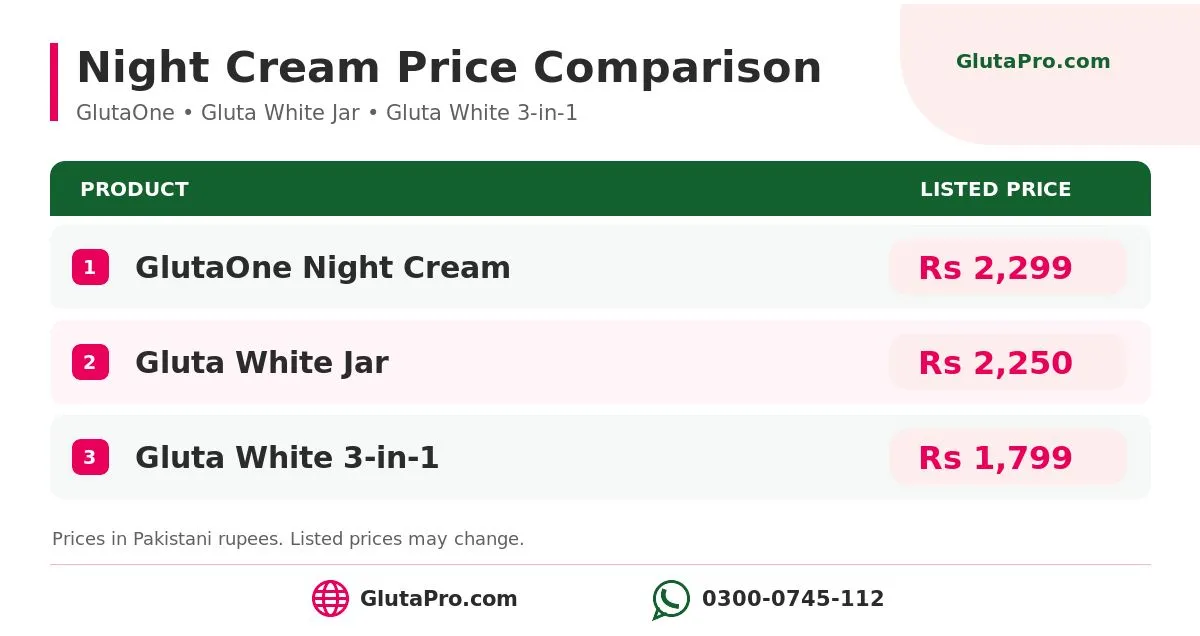
| Product | Disclosed actives | Best for | Price |
|---|---|---|---|
| GlutaOne Night Cream | Glutathione, kojic acid, vitamin C (named on the product page) | Our featured option at GlutaPro; sold as a medicated night cream with named actives | Rs 2,299 |
| Gluta White Cream Jar | Glutathione 0.5%, Alpha Arbutin 1%, Glycolic Acid 5%, Kojic Acid 2% (selected actives from the product-page table) | Buyers who want published ingredient percentages | Rs 2,250 |
| Gluta White 3-in-1 Night Cream | Alpha Arbutin, Niacinamide, Glutathione (triple-action trio; no percentages published) | Budget buyers who want the lowest listed price | Rs 1,799 |
GlutaOne Night Cream: Rs 2,299
GlutaOne Night Cream is our featured option at GlutaPro. It is the only product in this comparison explicitly sold as a medicated skin whitening cream, and its product page names glutathione, kojic acid and vitamin C among its actives, with usage directions to follow. To be clear, a marketing description is not proof of comparative effectiveness; it is featured here because its actives are named and its positioning is the most explicit of the three.
GlutaPro is an officially recognized authorized seller of GlutaOne Private Limited. On authenticity, note the contrast with Gluta White: GlutaOne has no verification-code system, so for this product authenticity rests on buying from the authorized seller rather than on checking a code. Be cautious of GlutaOne listings from unknown sellers. There is also a GlutaOne Night Cream and Serum bundle at Rs 4,199 for buyers who want the paired routine.
Who should consider it: buyers who want the featured medicated night cream option with named actives on the product page. Who should think twice: buyers on a tight budget (the 3-in-1 costs Rs 500 less), and buyers who insist on seeing published percentages before buying (the jar publishes selected percentages; GlutaOne’s page names actives without a percentage table).
Gluta White Cream Jar: Rs 2,250
The Gluta White Cream Jar is the transparency pick of this comparison. Its product-page table publishes selected actives: Glutathione 0.5%, Alpha Arbutin 1%, Glycolic Acid 5% and Kojic Acid 2%. Note what this table is and is not: it lists selected actives, not necessarily the complete ingredient list, so its order should not be read as a concentration ranking. Even with that limit, among the three products compared here, the jar’s product page provides selected ingredient percentages, which makes the jar the easiest of the three to evaluate on paper.
On authenticity, Gluta White is the brand with the verifiable system: original boxes carry a one-time verification code to check at glutawhite.info before first use. Our full guide explains how to check if your Gluta White cream is original, including what a valid result looks like and why re-entering the same code shows as invalid. That verifiability is a genuine advantage in a market full of fakes.
Who should consider it: buyers who compare disclosed formulas before buying, and buyers who want the code-based authenticity check. It is also covered in our best whitening cream in Pakistan (2026) comparison for the wider context.
Gluta White 3-in-1: Rs 1,799
The Gluta White 3-in-1 Night Cream is the budget pick at Rs 1,799, the lowest listed price in this comparison. It positions Alpha Arbutin, Niacinamide and Glutathione as its triple-action trio. Unlike the jar, no percentages are published for the 3-in-1, so you are buying on the strength of the named trio and the brand’s verifiable packaging rather than on a formula table.
The same Gluta White verification system applies: check the one-time code on the box at glutawhite.info before first use, and read our original vs fake guide so you know what to look for. Who should consider it: budget-conscious buyers who still want an original, verifiable product from the Gluta White range. Who should think twice: buyers who want published percentages (consider the jar) or the explicitly medicated night cream positioning (consider GlutaOne).
How to Read the Label
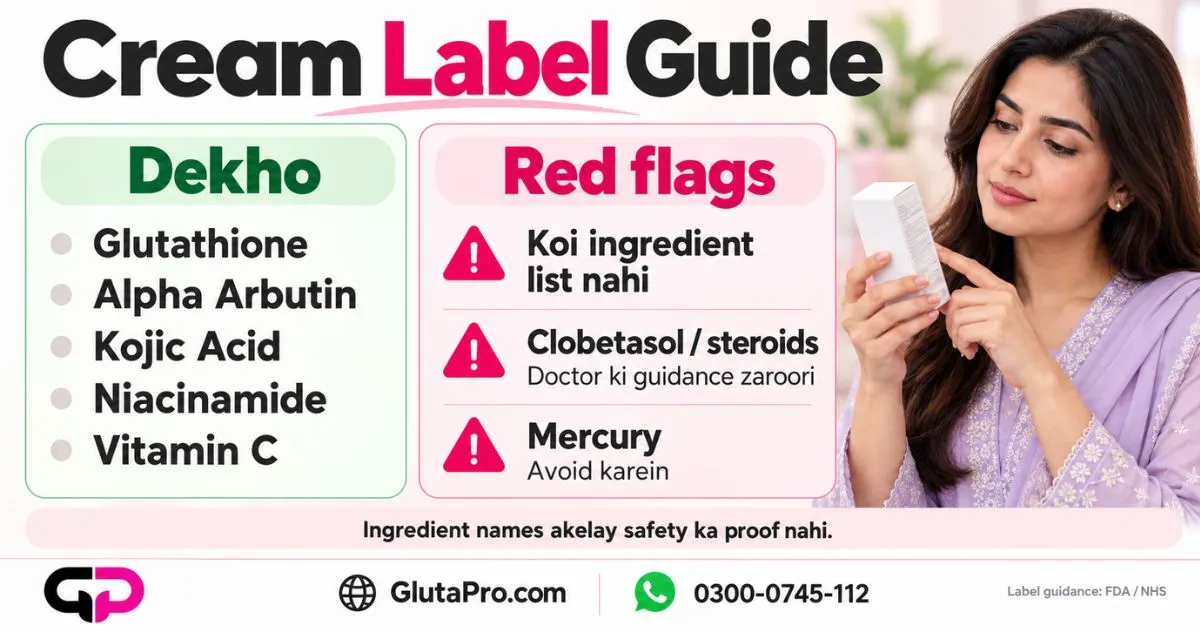
You do not need a chemistry degree to read a whitening cream label. You need two lists in your head: actives that are legitimate brightening ingredients with a track record, and red flags that mean you should walk away. Everything below applies whether you buy from GlutaPro or anywhere else.
Actives to look for
These are the ingredients that give an active-based whitening cream its function. A good label names them; a more transparent one gives percentages too:
- Glutathione: an antioxidant the body produces naturally, widely used in Pakistani whitening formulas. For the background, read our guide on whether glutathione is safe.
- Kojic acid (and kojic dipalmitate): a well-studied brightening active derived from fermentation. Note that “kojic acid” and “kojic acid dipalmitate” are related but distinct label wordings, so do not treat one as proof of the other.
- Vitamin C derivatives (e.g., ethyl ascorbic acid): antioxidant brighteners. “Vitamin C” on a label can mean several different derivatives, so the specific form matters more than the generic claim.
- Alpha arbutin: a widely used brightening agent, common in formulas aimed at dark spots.
- Niacinamide (vitamin B3): supports barrier function and evens tone; also useful for oily skin types.
- Glycolic acid: an exfoliating acid that helps other actives absorb. It appears at 5% in the Gluta White jar’s published selected-actives table.
- Hyaluronic acid and vitamin E: supporting ingredients for hydration and antioxidant protection rather than primary whitening agents.
One caution about reading tables like the jar’s published one: it lists selected actives, not necessarily the complete ingredient list, and its order does not tell you concentrations. A selected-actives table is a transparency signal, not a full formula disclosure. Judge it for what it discloses, and do not infer what it does not show.
Red flags on the label
Walk away, or at minimum investigate hard, when you see any of these:
- No ingredient list at all. This is the single biggest red flag. A legitimate manufacturer discloses what is inside the jar.
- Declared corticosteroids or unclear ingredient descriptions: if a whitening cream declares corticosteroids such as clobetasol, betamethasone, mometasone, fluocinonide or hydrocortisone, it is a medicine that requires medical supervision, not a fairness ingredient. Vague wording such as “anti-inflammatory complex” does not prove steroid presence; suspected undeclared ingredients cannot be confirmed without laboratory testing.
- Mercury or mercury compounds (calomel, mercuric, mercurio): restricted in cosmetics in most countries and still found in some unregulated creams, with documented risks to skin and, through absorption, to the kidneys.
- “Mix cream” or unlabelled jars prepared at a shop counter. You cannot verify what is inside, and these are a classic vehicle for undisclosed steroids.
- Miracle timelines (“7-day guaranteed fairness”). Real brightening from legitimate actives takes weeks of consistent use. Dramatic speed is a warning sign, not a selling point.
How to Test a New Cream at Home
Home testing is not the same as the diagnostic patch testing dermatologists perform with standardized allergen panels. It is a screening step you do yourself before full-face use, and it is worth doing for every active-based cream, including the products in this guide.
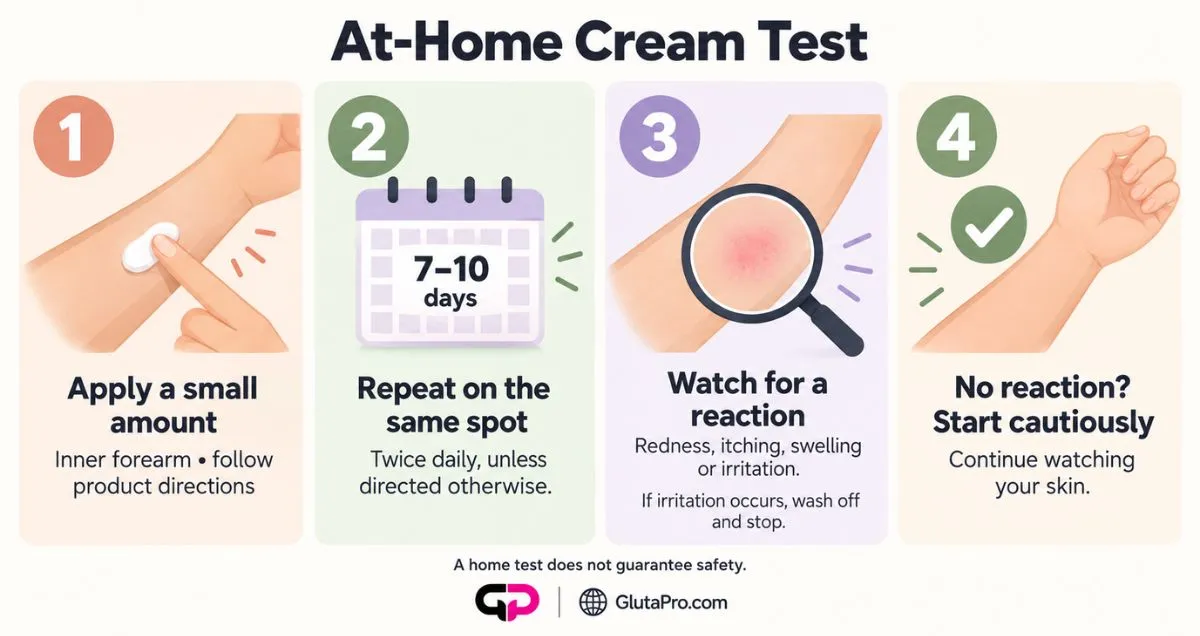
The American Academy of Dermatology describes at-home testing over about seven to ten days: apply the product to a quarter-sized spot on skin where it will not be rubbed or washed away, such as the underside of the arm or the bend of the elbow, twice daily, using the normal amount and thickness you would use regularly. Watch for redness, itching, burning, swelling or bumps across that period. If a reaction appears, wash the product off and stop using it. Test one new product at a time, so you can identify the cause if a problem appears.
Two honest limits to keep in mind. First, even products with fully disclosed ingredients, including ones labelled hypoallergenic or natural, can still cause irritation or allergy in some people; a label and a home test reduce risk but do not guarantee safety. Second, a calm test period does not promise the product will suit you forever. If irritation appears later during normal use, stop the product and reassess rather than pushing through.
When to See a Dermatologist
A blog guide can help you shop with better questions, but it cannot diagnose your skin. See a dermatologist promptly if any of the following apply. Do not wait out an arbitrary number of weeks first:
- Redness, itching or burning that persists after you stop the product.
- Seek prompt medical assessment for swelling, blistering, oozing or a spreading rash; these symptoms can have different causes.
- Pigmentation that persists despite consistent, correct use, or that spreads, darkens or changes shape. Conditions such as melasma or hormonal pigmentation need proper diagnosis, not a different cream.
- Pigmentation that appeared suddenly or has irregular borders. Unusual moles or patches should always be examined in person.
- You are pregnant or breastfeeding, since several active ingredients are not recommended during these periods.
- You have a history of eczema, rosacea or past reactions to steroids, which change which ingredients are appropriate for you.
- For detail on what different reactions can look like and when to stop using a product, read our Gluta White cream side effects guide.
If you have been using a suspected steroid cream for a long time, do not try to manage the transition alone; a dermatologist can plan a safe taper and repair routine.
Using a Night Cream in Your Routine
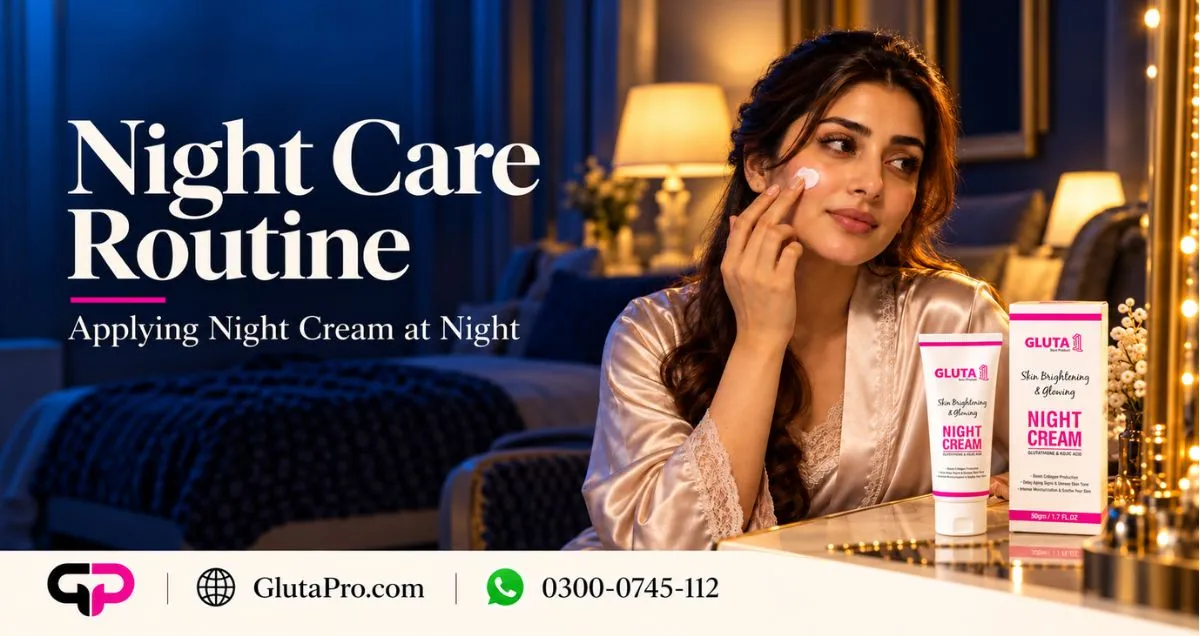
GlutaOne Night Cream and the Gluta White 3-in-1 are sold as night creams, so follow each product’s own directions for when and how to apply. One scoped caution: formulas containing AHAs such as glycolic acid, which the jar’s published table lists at 5%, can increase sun sensitivity, which makes daytime sunscreen especially important with those formulas. Do not extend that caution to every brightening active by default; check the product’s directions and its ingredient list instead of assuming.
- Cleanse in the evening with a gentle face wash to remove sunscreen, dust and oil.
- Apply a pea-sized amount to the face, avoiding the immediate eye area unless the label says otherwise. More product does not mean faster results; it means more irritation risk.
- Moisturize if needed. Use a moisturizer if needed and compatible with the product’s directions. Persistent tightness or irritation should prompt reassessment.
- Sunscreen every morning, without exception. Whitening actives cannot outpace daily sun exposure. If you skip sunscreen, you are paying for a cream while undoing its work every afternoon.
- Judge over several weeks, not days. Skin renews gradually, so a few days tell you nothing. If pigmentation persists despite correct use, or you notice a reaction, see a dermatologist rather than waiting for a fixed number of weeks.
One more habit worth building: take a photo in the same lighting every two weeks. Memory is a poor judge of gradual change, and a simple photo log keeps expectations honest.
Rang Gora Karne Wali Medicated Cream Kaunsi Hai?
Seedha jawab: is guide mein GlutaOne Night Cream (Rs 2,299) hamari featured option hai; ye medicated night cream ke tor par bechi jaati hai aur is ke ajza ke naam product page par diye gaye hain. Gluta White Cream Jar (Rs 2,250) un ke liye hai jo published percentages dekh kar faisla karna chahte hain, aur Gluta White 3-in-1 (Rs 1,799) budget option hai.
“Medicated” ka matlab ye nahi ke product ki regulatory status label dekh kar sabit ho gayi; asal sawal ajza ki disclosure hai. Steroid wali creams tibbi nigrani ke baghair istemal na karen, aur full-face istemal se pehle product test zaroor karen. Qeemat aur ajza ka mukabla oopar di gayi table mein dekh sakte hain.
FAQs
Which is the best medicated whitening cream in Pakistan?
Our featured option at GlutaPro is GlutaOne Night Cream (Rs 2,299), sold as a medicated night cream with named actives, from GlutaPro as an officially recognized authorized seller of GlutaOne Private Limited. The Gluta White Cream Jar (Rs 2,250) discloses selected ingredient percentages, and the Gluta White 3-in-1 (Rs 1,799) is the budget pick. A marketing description is not proof of comparative effectiveness, so match the disclosed formula and the authenticity method you can verify to your own needs.
Is medicated whitening cream safe?
Creams with fully disclosed ingredients can still cause irritation or allergic reactions in some people; disclosure and home testing reduce risk but do not guarantee safety. The larger documented risks in this market come from hidden ingredients, especially undeclared steroids or mercury, which is why a missing ingredient list is itself a red flag. Stop use if irritation appears, and see a dermatologist for persistent or severe reactions.
Rang gora karne wali medicated cream kaunsi hai?
Is guide mein GlutaOne Night Cream (Rs 2,299) aur Gluta White cream (jar Rs 2,250, 3-in-1 Rs 1,799) ka mawazna kiya gaya hai; ajza ki disclosure aur qeemat oopar di gayi table mein dekhen. Full-face istemal se pehle product test zaroor karen, aur Gluta White ki cream ka verification code pehli dafa istemal se pehle check karen.
How long does a medicated whitening cream take to work?
Legitimate brightening actives work with the skin’s gradual renewal, so visible change usually takes several weeks of consistent use, not days. Use sunscreen every morning during this period, since sun exposure undoes brightening progress. If pigmentation persists despite correct use, or you notice irritation, consult a dermatologist rather than waiting for a fixed number of weeks.
For the wider price and ingredient comparison across more creams, see our best whitening cream in Pakistan (2026) guide.